


Kanazawa - Day 2
- Dec 8, 2025
- 4 min read
November 11, 2025 - from the itinerary: Private Kanazawa Tour: Discover the vibrant heart of Kanazawa on a bespoke full-day tour with your private guide. You'll savor the bustling atmosphere of Omicho Market, appreciate the artistry at the Ohi Ceramics Museum and the Kanazawa Museum of Gold leaf. (note - we did this day 1).
Today’s breakfast was similar to yesterday’s, but each day there is a slight variation.
Hero and I spent most of today at the Kanazawa Castle, originally owned by the Maeda Family. Our first stop was the Museum of Traditional Arts and Crafts, showing examples of arts and crafts developed in the Ishikawa Region, like lacquerware, silk, gold leaf, and candles. One ancestor decided he needed a tea room covered with gold leaf.


Just next to the garden, but on the castle grounds, we were able to walk through Seison-Kaku, built in 1863 for the mother of the 13th lord of the Kaga clan. It was originally 3 times bigger, but was already huge - 2 floors and about 3000 square feet. It contained electric light chandeliers from the US, glass tiles from the Netherlands, and beautiful paintings along the wainscotting. They used cantilevered roofs to allow an undisturbed views of the gardens. It included a room the emperor used when he visited.


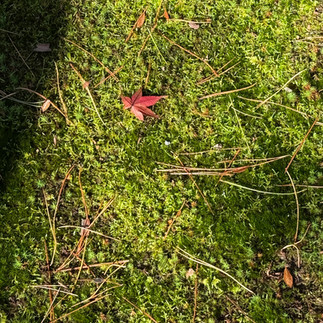
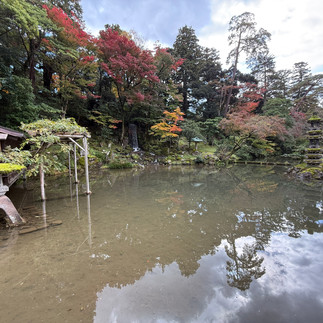
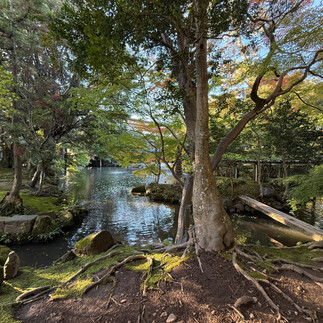
From there we spent a few hours walking through the Kenrokuen Garden, the original garden of the castle. It is 450+ years old. There were many types of moss which was luxuriant and curated. Also the quince trees had a lot of fruit.



Here we saw the well from which the plant is harvested for the gold leaf paper used in production.


We walked through torii gates to a shrine for students. This is where students pray to pass their exams and/or gain entrance to the school of choice.





We saw the gardeners preparing the trees and shrubbery for winter which was sometime more interesting than the garden itself.
This garden contains the famous Kotojitoro Lantern, a Japanese landmark and one of the most iconic Japanese sculptures in the most beautiful garden in Japan.



Of course it also contains ponds with fat koi waiting to be fed.


And some other pretty things


The castle and gardens use a unique watercourse/water channel system which takes the water from nearby rivers and brings it to the castle and gardens. This water channel also feeds the oldest fountain in Japan which uses only natural pressure, not water pumps, to force the water up into a 3.5M spray.


The local hills and Mountain View’s are integrated with the garden and, in olden times, commoners were not allowed to walk in these hills because it was thought they could spy into the castle grounds.
This is Sekirei Island which is said to reflect birth, marriage and death by its combinations of rocks and trees.


and rocks that looked like various animals that were near an old tea house - one of the near original buildings on the site


From here we wandered over to the castle itself. Although originally built hundreds of years ago, it burned down several times and was also affected by earthquakes. All that remains of the “original” is one gate and a store house and these were only rebuilt a couple hundred years ago. The big fire occurred only during WW2 when the Japanese soldiers started an accidental fire which burned down the 60 room castle and most of its outbuildings. The walls use a unique sea cucumber design developed so it looks like tiles on the outside, but the inside has regular areas where the tiles can be pushed out if holes are needed to fire at the enemy.


The government has rebuilt one long defensive wall (pictured in front) and is starting to build part of the main castle building (scaffolding in back), but it won’t be completed for many years. It is being rebuilt with tax payer money and has already cost hundreds of millions of US dollars to get even this far.


We stopped for tea and a cake by the castle


And then went over to the Kaga-Yuzen Kimono Center. This school of dyeing dates back some 500 years. In the mid-1600s pattern and picture dyeing were introduced. No one is buying kimonos any more because they are very expensive and there’s no where to wear them. When needed, people usually rent them, as new they cost over one million yen. They are still worn for weddings and funerals - in fact we saw a couple having some wedding photos in the garden.


Kimono making, like geisha, is becoming a vanishing art form.
Our last stop was at the zen museum, celebrating the prominent Buddhist philosopher D. T. Suzuki. The building focus was on three basic forms: square, circle, and triangle. It showed photos from his life, talked about his many books, and offered areas for contemplation.



Dinner was a bit too adventurous even for me. I couldn’t eat most of it and was happy for the sushi and sashimi courses. The “gelato” was green tea/vanilla mix of ice cream which was very nice. I went back to the room and had some rice cakes and mochi to fill the holes….


Comments